

Reevaluating Vitamin D Guidelines: Why Vitamin D3 and K2 Dosages Are Critical
Reevaluating Vitamin D Guidelines: Why Vitamin D3 and K2 Dosages Are Critical
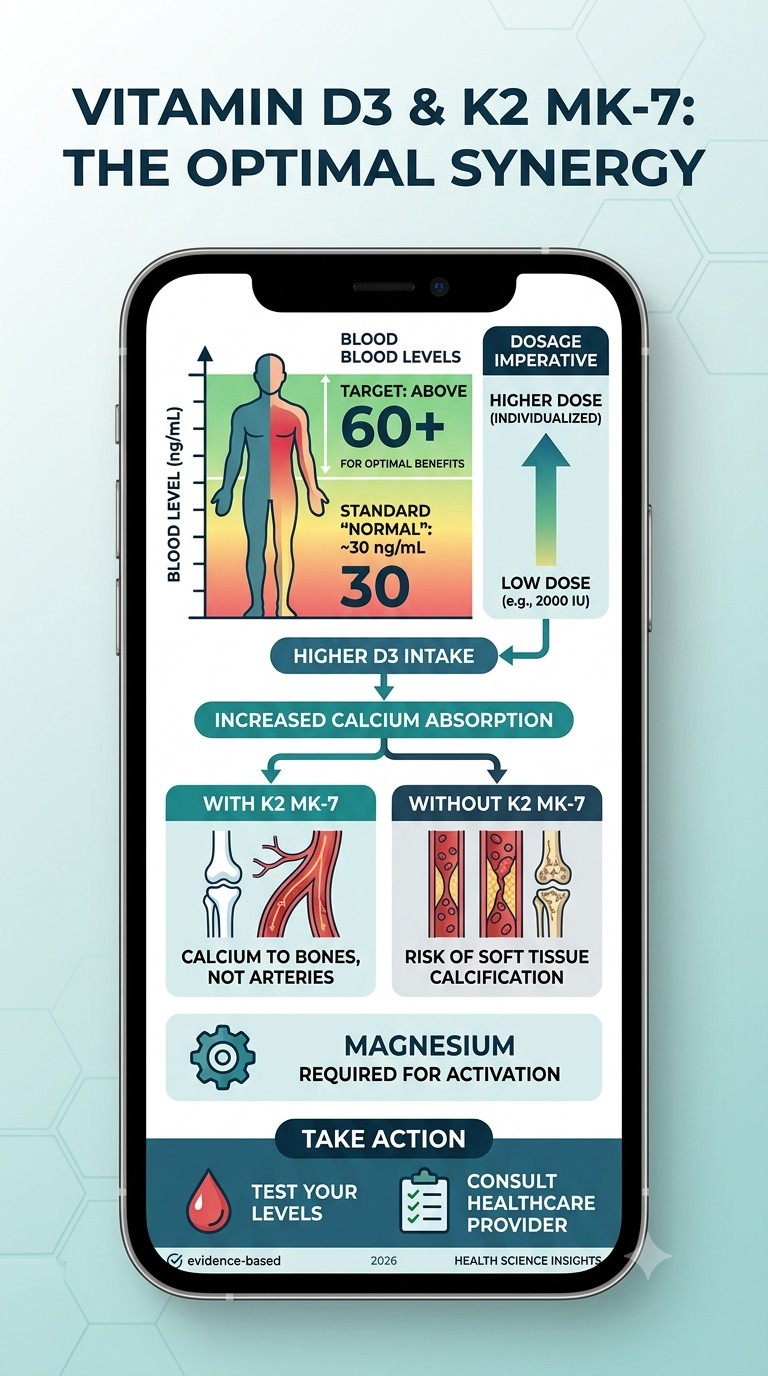
For years, mainstream medical guidelines have advocated for modest Vitamin D targets, frequently identifying a blood serum level of 30 ng/mL as adequate. However, evidence buried within major clinical trials and clinical observations indicates that standard daily regimens—often ranging from 600 to 2,000 IU—fail to achieve the blood concentrations necessary for broad disease prevention. To unlock the full protective benefits against aggressive malignancies, chronic illness, and autoimmune conditions, evidence points to the necessity of significantly higher daily intakes of Vitamin D3 combined synergistically with Vitamin K2 MK-7 and Magnesium.
The VITAL Study Deficit and the 60 ng/mL Threshold
The widely cited VITAL study, which tracked over 25,000 participants over five years, initially led headlines to declare that Vitamin D supplementation yields no significant reduction in overall cancer risk. However, a major structural limitation of the trial was its uniform daily dosage of merely 2,000 IU. As Dan Zatarski, PharmD, highlighted in his critique of the published data: > “The research on vitamin D is robust. It’s not preliminary, it’s not promising, but it is very strong evidence… The problem is the dose… It’s not an issue of does vitamin D work or not… What dose do we need to get to 60? If you take anything away today, know this: You have to get above 60 nanograms per milliliter in your blood of vitamin D3 hydroxy in order to achieve this risk reduction.” — Dan Zatarski, PharmD, MD Custom Rx, 2026
When researchers conducted deeper sub-analyses of the VITAL data, a different picture emerged: participants with a normal Body Mass Index (BMI under 25) experienced a 38% lower risk of advanced, aggressive cancers. Because Vitamin D is lipophilic (fat-soluble), higher volumes of body fat absorb the nutrient, preventing individuals with higher BMIs from reaching therapeutic threshold levels without adjusted higher doses. Furthermore, a separate observational analysis revealed that women who maintained blood concentrations above 60 ng/mL experienced an 80% reduction in breast cancer risk compared to those with levels below 20 ng/mL.
Overcoming Lab Range Misconceptions and Clinical Resistance
The disparity between standard lab ranges and optimal health targets leaves many patients improperly managed. Conventional lab reports label blood levels around 30 ng/mL as “normal,” prompting many practitioners to discourage supplementation when patients exceed this baseline. One commenter detailed this system-wide measurement issue: > “5000IU is only 125mcg. That’s barely one eighth of a single milligram. A long time ago, they (the powers that be) intentionally changed the measurement to IUs (International Units) to make it sound like it’s a large amount and psychologically discourage people from taking enough to keep them healthy.” — @ethereal369, 2026
Because of rigid adherence to outdated standard limits, patients who achieve optimal levels often face unnecessary pushback from their physicians. As one individual reported: > “I was at 70 vitamin D levels and my doctor was terrified and said we need to get you down to 30ish levels so I was to stop supplementing. I just stopped going to that doctor.” — @gamingwithmrgvil3511, 2026
Another patient shared a similar encounter regarding traditional medical guidance: > “Mine was also 82 last fall. My primary was beside himself and strongly urged me to stop taking D3 for 3 months… Some Drs have not gotten caught up with the Science.” — @avgejoeschmoe2027, 2026
Modern Mechanisms: The p53 Protein and Gut Microbiome Immunity
Beyond broad preventative metrics, Vitamin D directly influences precise molecular and immunological pathways. In a notable Japanese study on gastrointestinal cancers, researchers evaluated the p53 gene—a protein that acts as the body’s internal “cancer alarm system” to initiate apoptosis (programmed cell death) in damaged cells. In cases where gastrointestinal tumors had not completely disabled this pathway, participants receiving Vitamin D experienced a dramatic reduction in relapse or death (9 out of 54) compared to the placebo group (14 out of 26), reflecting a hazard ratio of 0.27.
Additionally, emerging research highlights a novel mechanism: microbiome-dependent cancer immunity. Vitamin D interfaces directly with the gastrointestinal tract to alter bacterial composition—specifically supporting beneficial strains such as Bacteroides fragilis. This interaction enhances the immune system’s ability to perform surveillance and identify atypical cells, providing critical support that synergizes with modern immunotherapy and cancer treatments.
Patient Outcomes on High-Dose Protocols and Essential Co-Factors
Real-world experiences consistently demonstrate that resolving severe health challenges requires moving past standard baseline recommendations. A patient managing autoimmune disease shared the direct impact of high-dose supplementation on their condition: > “I have lupus. Had at a very low d3 (12) at that time. Years of ivs, steroids etc. I went into remission with my d3 level a 120, Taking k2 with 50k d3 every 2 weeks and 300mg of magnesium and 600mg NAC daily. I stopped cause my doc told me its dangerous. My d3 level bumped to 30 within 8 months and lupus returned. Just got back on my old routine and now at 80 d3 feeling 1000% better.” — @akaWilderJackson, 2026
However, taking elevated doses of Vitamin D3 necessitates proper co-factors to ensure physiological safety and efficiency. Vitamin D significantly increases calcium absorption from the gut. To prevent this calcium from depositing into soft tissues or the cardiovascular system, Vitamin K2 (specifically MK-7) and Magnesium must be taken concurrently. Magnesium is required to hydroxylate and activate Vitamin D in the liver and kidneys, while Vitamin K2 directs calcium into the bone matrix.
Patients utilizing this synergistic combination report long-term success in reaching and maintaining target blood levels: > “When I was diagnosed with CAD 3 yrs ago my Vit D was only 17… During my check up last year my Vit D had improved to 59. However at this level my cardiologist warned that at that level of supplementation (20,000 IU per week) I was at risk of hypercalcemia. I chose to ignore her warning, and in fact I’m now taking 5,000 IU per day with 300 mcg of K2-MK7, and magnesium… UPDATE: as per my latest bloodwork, my vit D level came in at 62 by having a daily intake of 5,000 IU.” — @MarkRobert-BKK, 2026
Actionable Steps for Optimization
To ensure safe and effective optimization, health management should focus on verified blood metrics rather than arbitrary dosage numbers. First, obtain a 25-Hydroxy Vitamin D test to establish your true baseline serum level through a standard blood panel. Next, aim to reach and maintain an optimal threshold level above 60 ng/mL rather than settling for the conventional normal limit of 30 ng/mL. In addition, always include synergistic co-factors by pairing higher Vitamin D3 intakes with Vitamin K2 MK-7 to protect cardiovascular health and Magnesium to enable proper enzymatic conversion. Finally, tailor your daily intake based on BMI, individual absorption capability, and follow-up lab results in consultation with an open-minded healthcare practitioner.